Home Warranty vs Emergency Fund: Which Saves More?
Picture this: your furnace coughs on the first cold night, your fridge starts to warm up, and the electrician says the panel is overdue for replacement. Do you want a predictable yearly cost that gets a pro to your door, or would you rather bank the cash and take your chances when something fails? That is the real tradeoff in the Home Warranty vs Emergency Fund decision.
CustomerAffairs and other statistics websites have calculated that homeowners typically spend $3,000–$5,000 annually on unexpected repairs. With 46% facing at least one issue in the past year, making an emergency fund of 1–3% of home value (e.g., $4,000–$12,000 for a $400,000 home) often more savings-effective than a home warranty, which averages $450–$1,200 yearly plus $75–$150 deductibles but frequently results in denied claims or capped payouts that don’t fully cover costs.
A home warranty converts unexpected breakdowns into scheduled expenses, accompanied by a premium and a service fee. An emergency fund gives you full control and the opportunity to save money if nothing major happens. Both can work. The question is which one matches your home’s age, your budget, and how much volatility you can handle.
What This Comparison Home Warranty vs Emergency Fund Means
Quick definitions
- Home warranty is a service contract that helps pay for repairs or replacements of covered home systems and appliances due to wear and tear. You pay a yearly premium and a set service fee when you file a claim. Coverage lists, caps, and exclusions apply. This can help find the right Home Warranty Company.
- Emergency fund is a cash you set aside to cover unexpected home costs on your own. No premiums, no claim rules. You shoulder the full bill when something breaks.
How they work together vs. separately
- Separately:
- Warranty converts surprise repairs into predictable costs but limits payouts to covered items and dollar caps.
- Emergency fund gives total flexibility but exposes you to full price swings and contractor hunting.
- Together (hybrid):
- Use a warranty to cap big ticket risks like HVAC or major appliances.
- Keep a smaller cash buffer for uncovered items, code upgrades, permits, and timing gaps.
TL;DR: when each tends to win on savings
- Home warranty wins when your systems are older, repair prices are high where you live, or you prefer quick access to vetted pros with capped out-of-pocket risk.
- Emergency fund wins when your equipment is newer, you are comfortable sourcing contractors, and you can absorb a rare big bill without stress.
- Hybrid wins when you want the warranty’s predictability for major systems and the emergency fund’s flexibility for everything else.
The Fast Answer
When you strip it down, Home Warranty vs Emergency Fund is a choice between predictable payments and flexible control. Use this quick filter to decide:
Choose a Home Warranty if:
- Your systems and appliances are mid to late life.
- You want predictable costs and set service fees.
- You value fast access to vetted pros through a clear claim process.
- You prefer capping worst-case expenses rather than guessing repair prices.
Choose an Emergency Fund if:
- Your systems are newer or recently replaced.
- You’re comfortable sourcing contractors and managing repairs yourself.
- You can absorb a surprise bill without derailing your budget.
- You want full control over parts, timelines, and who does the work.
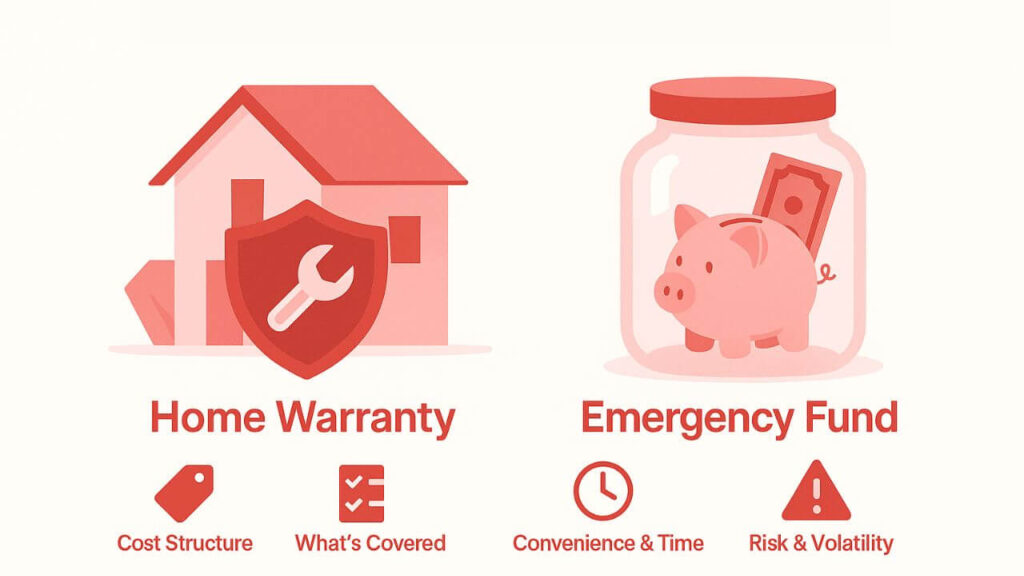
Side-by-Side Snapshot
Cost Structure
Home warranty: Annual premium plus a fixed service fee per approved claim. Predictable out-of-pocket, even in a busy year.
Emergency fund: Fully variable. Your spend depends on what fails, parts availability, and local labor rates.
What’s Covered
Home warranty: Specific systems and appliances for wear and tear, subject to coverage lists, dollar caps, and exclusions.
Emergency fund: Anything you choose to fix or replace, but there are no negotiated rates or built-in discounts.
Convenience & Time
Home warranty: One call, a clear claim process, and access to networked pros. Usually faster to diagnose and schedule.
Emergency fund: You handle everything: sourcing quotes, vetting contractors, scheduling, and follow-ups.
Risk & Volatility
Home warranty: Caps your exposure on covered items but also limits payouts and may deny non-covered issues.
Emergency fund: Unlimited exposure to big bills, but full control over parts, timelines, and repair quality.
Run the Numbers
Annual Cost Formula
- Warranty “all-in” this year = Premium + (Expected claims × Service fee)
Tip: “Expected claims” can be decimal (e.g., 1.3 if you think you’ll file 1–2 claims). - Emergency fund expected spend = Σ(Probability of failure × Average repair cost for each major item)
Mini worksheet
- List 5–7 big items (HVAC, water heater, fridge, etc.).
- For each: estimate failure probability this year and a realistic repair bill.
- Multiply and add them up → that’s your expected emergency spend.
- Compared to your warranty all-in.
Break-Even Check
- If expected emergency spend > warranty all-in, a warranty likely saves more.
- If expected emergency spend < warranty all-in, the emergency fund likely saves more.
Quick examples:
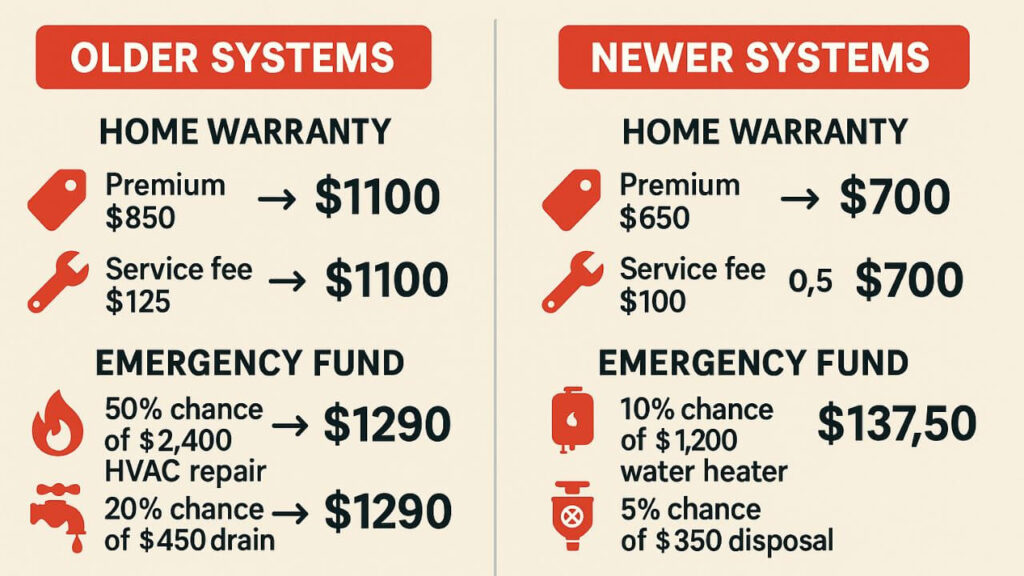
Older Systems (10–15 years old)
Home Warranty Option:
- Annual premium: $850
- Service fee per call: $125
- Expected number of claims per year: 2.0
Older Systems (10–15 years old)
Home Warranty Option:
- Annual premium: $850
- Service fee per call: $125
- Expected number of claims per year: 2.0
Total expected yearly cost:
$850 + (2 × $125) = $1,100
Emergency Fund Option:
- 50% chance of a $2,400 HVAC repair
- 20% chance of a $450 drain clear
(0.5 × $2,400) + (0.2 × $450) = $1,200 + $90 = $1,290
Result: Home warranty wins ($1,100 vs. $1,290)
Newer Systems (Under 5 years old)
Home Warranty Option:
- Annual premium: $650
- Service fee per call: $100
- Expected number of claims per year: 0.5
Total expected yearly cost:
$650 + (0.5 × $100) = $700
Emergency Fund Option:
- 10% chance of a $1,200 water-heater repair
- 5% chance of a $350 garbage disposal repair
(0.1 × $1,200) + (0.05 × $350) = $120 + $17.50 = $137.50
Result: Emergency fund wins ($137.50 vs. $700)
Common Repairs to Price Out
- HVAC compressor or blower motor
- Furnace control board/igniter
- Water heater (tank or valve)
- Refrigerator sealed system
- Main drain/sewer line stoppage
- Electrical panel/breaker issues
Pro move: Get 2–3 local quotes (or use past invoices) for each item so your math reflects your market, not national averages.
Hidden Variables That Tilt the Math
Claim caps and exclusions
Read the fine print. Many plans set per-item and aggregate caps and exclude certain parts or failure causes. If a repair exceeds the cap, you pay the difference. If a component is excluded, the claim can be denied entirely. Always compare caps to real replacement costs in your market.
Pre-existing conditions and maintenance requirements
Warranties usually require proof of proper installation and routine maintenance. If a contractor notes neglect or a pre-existing issue, coverage may not apply. Keep service receipts and seasonal tune-up records so claims move faster and stay eligible.
Response times and contractor quality
Fast dispatch saves money and downtime. Slow scheduling can force temporary fixes or emergency rates. Ask about average response times, weekend coverage, and whether you can choose your own contractor if the network is backed up. Quality work reduces repeat failures.
Local labor and material price swings
Your math changes with your ZIP code. High labor rates, supply constraints, and specialty parts inflate repair bills. In expensive or rural markets, the warranty’s negotiated pricing and caps can offer stronger savings than national averages suggest. Get two or three local quotes to ground your assumptions.
HomeMembership Tip
Before you renew, match each plan’s per-item cap against your real replacement costs, and confirm your exact model numbers are listed as covered. Then book a seasonal HVAC and appliance tune-up, that it keeps receipts on file for claims and helps prevent breakdowns (and downtime) in the first place.
The Bottom Line
Home Warranty vs Emergency Fund comes down to what you value most. Home warranties buy predictability and time. Emergency funds buy flexibility and control. If your systems are older and you want set costs with quick access to vetted pros, a warranty is likely the better pick. If your equipment is newer and you can handle the occasional big bill, the emergency fund can save more. Many homeowners choose a hybrid to balance risk and cost. Match the option to your home’s age, your budget, and your risk tolerance to win the Home Warranty vs Emergency Fund decision.
Related Posts