What Is a Home Warranty? The Complete Guide for Homeowners
Home systems and appliances keep your household running every day, until something breaks.
Air conditioners fail, water heaters stop heating, dishwashers leak, electrical outlets short out, and repair bills add up fast. A home warranty exists to reduce that risk and give homeowners clearer, more predictable protection when essential items wear down.
Recent market research shows that home warranties are still far from universal, but they’re widely used in certain segments like older homes and real estate transactions. One report shows that about 20% of U.S. homeowners had a home warranty in 2024, and according to IBISWorld and other industry analyses suggest that active contracts cover only around 5% of all U.S. households at any given time.
Industry research from IBISWorld estimates that U.S. home warranty providers generated about $3.7 billion in revenue in 2023 after growing at roughly 2.5% per year since 2018, while ConsumerAffairs puts the 2023 figure closer to $3.9 billion. A 2024 forecast by Verified Market Research values the U.S. market at about $4.26 billion in 2024 and projects it to reach roughly $5.7 billion by 2032.
This page explains what is a home warranty, how it works behind the scenes, what it covers, what it doesn’t, and how to determine whether it’s right for your home.
You’ll also find an explanation of how we at HomeMembership approach the service.
Definition: What Is a Home Warranty?
A home warranty is a service contract that covers the repair or replacement of major home systems and appliances when they fail from normal wear and tear. Here are not included disasters, accidents, and not misuse.
Unlike homeowners insurance (which covers fires, storms, theft, and structural damage), a home warranty focuses on everyday mechanical breakdowns of items like:
- HVAC systems
- Plumbing and water heaters
- Electrical systems
- Appliances such as refrigerators, ovens, dishwashers, washers and dryers
You can learn more about the history of Home Warranty.
Why Home Warranties Exist
Systems and appliances age. Components wear down.
Repair bills can jump from a few hundred to several thousand dollars without warning.

A home warranty turns unpredictable costs into predictable budgeting through:
- A yearly or monthly premium
- A fixed service fee per claim
- Access to qualified repair technicians
At HomeMembership, we focus on making this process simple, transparent, and easy to understand, which is often not the case with larger national competitors.
How a Home Warranty Works (Step-By-Step)
A home warranty follows a predictable workflow. While every provider has differences, the core process looks like this:
A System or Appliance Breaks
Wear and tear eventually causes mechanical failures.
Examples include:
- AC stops cooling
- Water heater leaks
- Dishwasher won’t drain
- Breakers keep tripping
- Furnace won’t ignite
You Submit a Claim
Most companies offer:
- Online claim portals
- Phone support
- Emergency request lines
At HomeMembership, we keep the claim process straightforward so homeowners aren’t guessing what to expect.
A Technician Is Assigned
This is where providers differ significantly.
- Many companies assign a contractor from their internal network.
- Some companies do not allow customers to choose their own technician (a point of frustration for many homeowners).
At HomeMembership, we allow you to choose your own contractor if you prefer, which gives homeowners more control and often faster service.
The Issue Is Repaired or Replaced
If the issue is:
- Covered → the warranty pays for repair/replacement up to the contract limit.
- Not covered → the technician explains why.
Coverage Caps Apply
Every warranty has coverage limits, usually per item or per contract term.
The homeowner pays only the portion above those caps.
What a Home Warranty Covers (Systems, Appliances, Add-Ons)
This section breaks down coverage categories, real examples, and how different items are treated in a claim.
Major Home Systems Coverage
Home systems are the core of most warranty plans. These are the components that run your home’s essential functions.
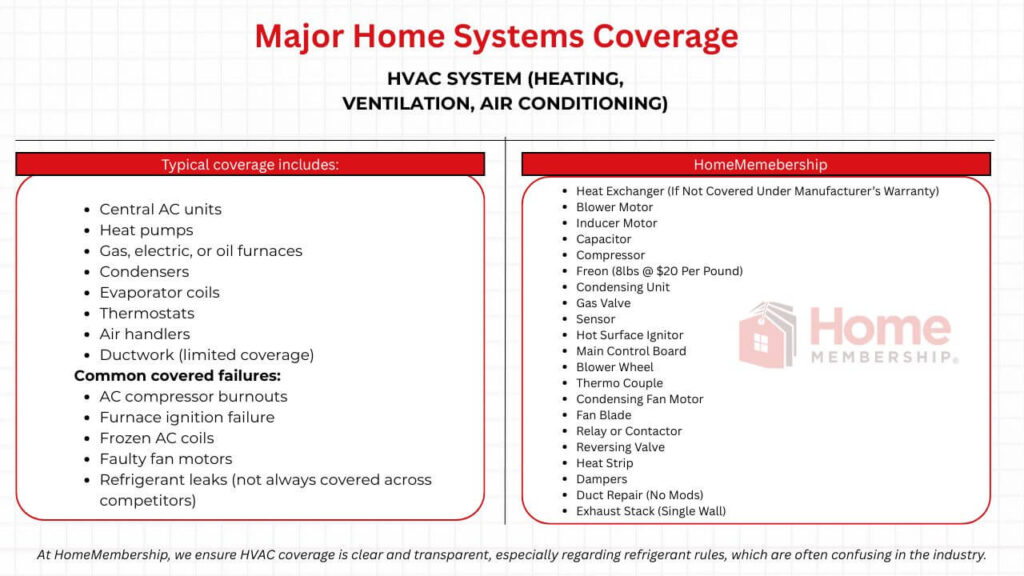
- HVAC System (Heating, Ventilation, Air Conditioning)
One of the highest-value components in any home warranty.
Typical coverage includes:
- Central AC units
- Heat pumps
- Gas, electric, or oil furnaces
- Condensers
- Evaporator coils
- Thermostats
- Air handlers
- Ductwork (limited coverage)
Common covered failures:
- AC compressor burnouts
- Furnace ignition failure
- Frozen AC coils
- Faulty fan motors
- Refrigerant leaks (not always covered across competitors)
At HomeMembership, we ensure that HVAC coverage is clear and transparent, particularly regarding refrigerant rules, which can be confusing in the industry. Here, you can find the complete list of what is covered by HomeMembership.
2. Plumbing System
Plumbing failures are among the most stressful for homeowners.
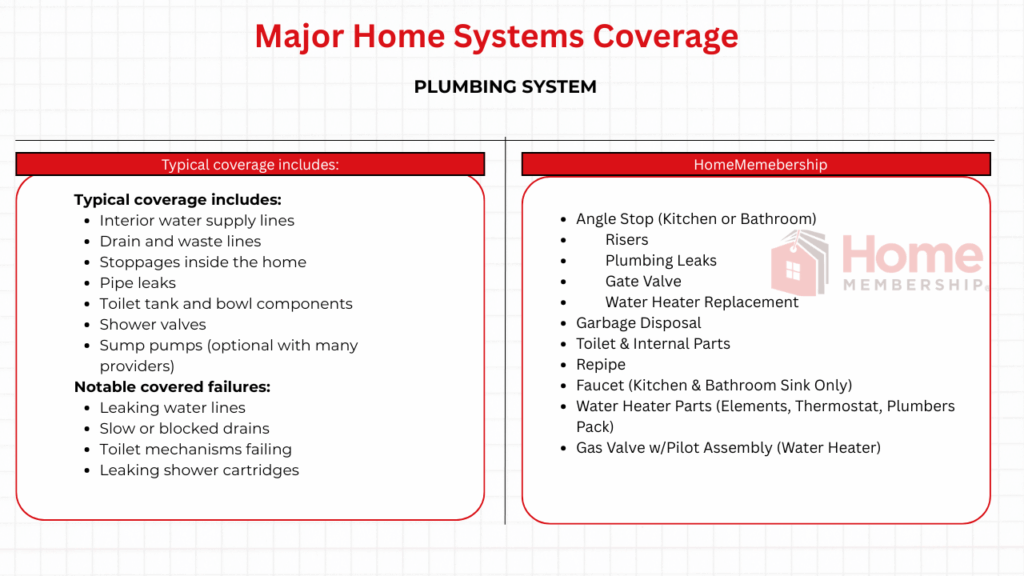
Typical coverage includes:
- Interior water supply lines
- Drain and waste lines
- Stoppages inside the home
- Pipe leaks
- Toilet tank and bowl components
- Shower valves
- Sump pumps (optional with many providers)
Notable covered failures:
- Leaking water lines
- Slow or blocked drains
- Toilet mechanisms failing
- Leaking shower cartridges
3. Electrical System
Electrical problems can be both dangerous and expensive.
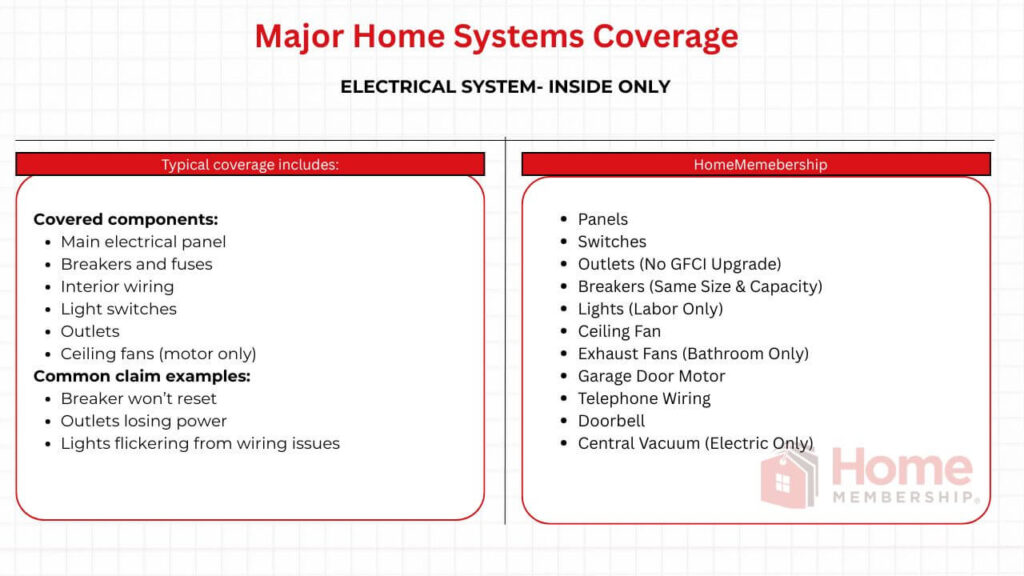
Covered components:
- Main electrical panel
- Breakers and fuses
- Interior wiring
- Light switches
- Outlets
- Ceiling fans (motor only)
Common claim examples:
- Breaker won’t reset
- Outlets losing power
- Lights flickering from wiring issues
Major Appliances Coverage
Appliances break down more often than structural items. A home warranty helps offset the repair/replacement cost.
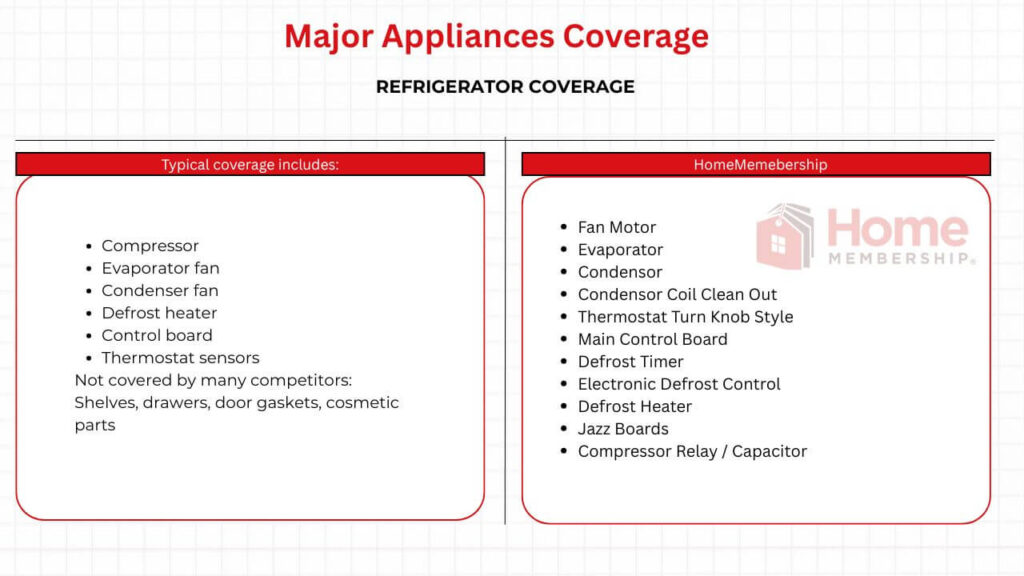
1. Refrigerator
Usually covers mechanical parts like:
- Compressor
- Evaporator fan
- Condenser fan
- Defrost heater
- Control board
- Thermostat sensors
Not covered by many competitors:
- Shelves, drawers, door gaskets, cosmetic parts
2. Dishwasher
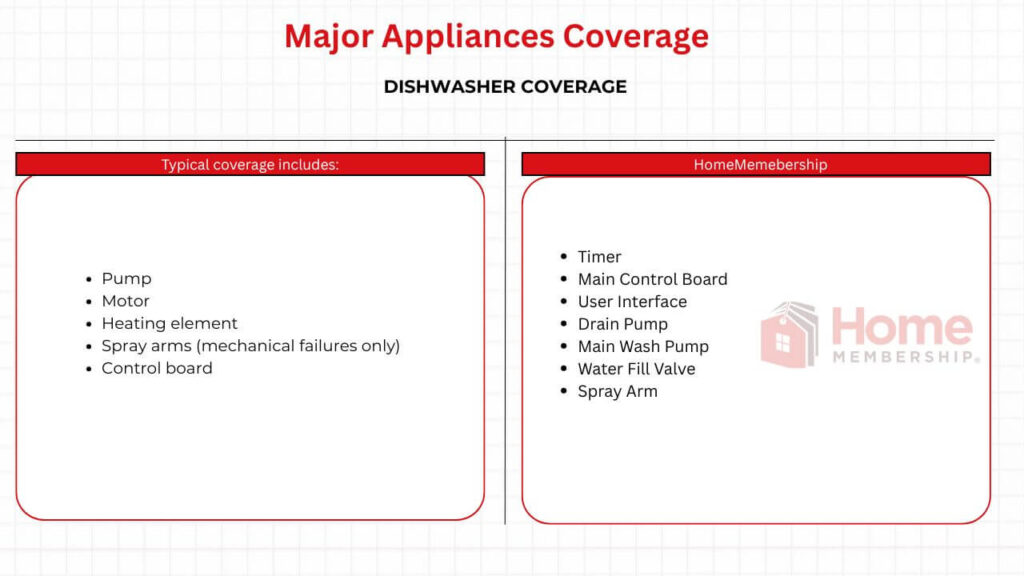
Covers mechanical failures such as:
- Pump
- Motor
- Heating element
- Spray arms (mechanical failures only)
- Control board
3. Oven, Range, Cooktop
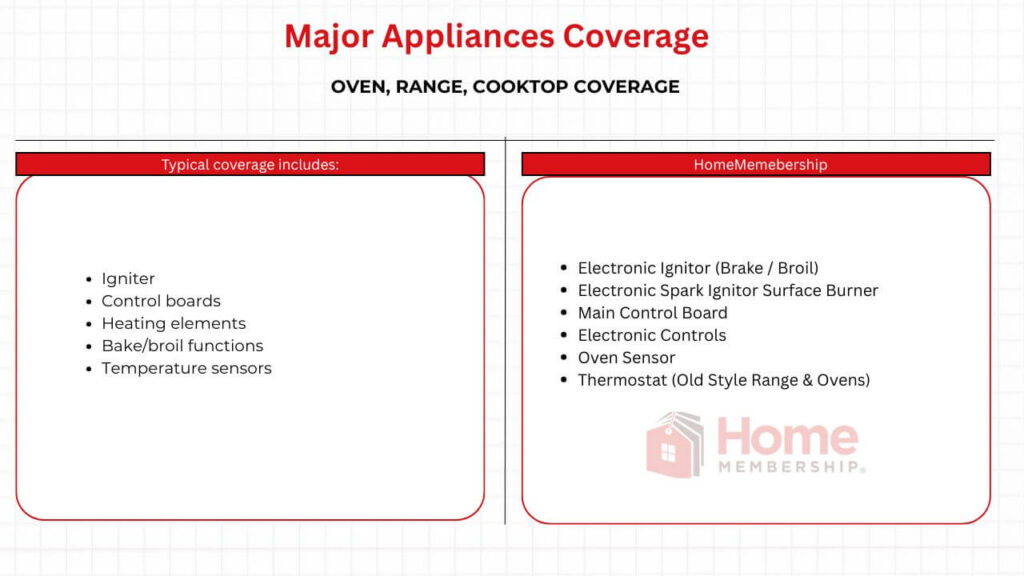
Covered components:
- Igniter
- Control boards
- Heating elements
- Bake/broil functions
- Temperature sensors
5. Washer & Dryer
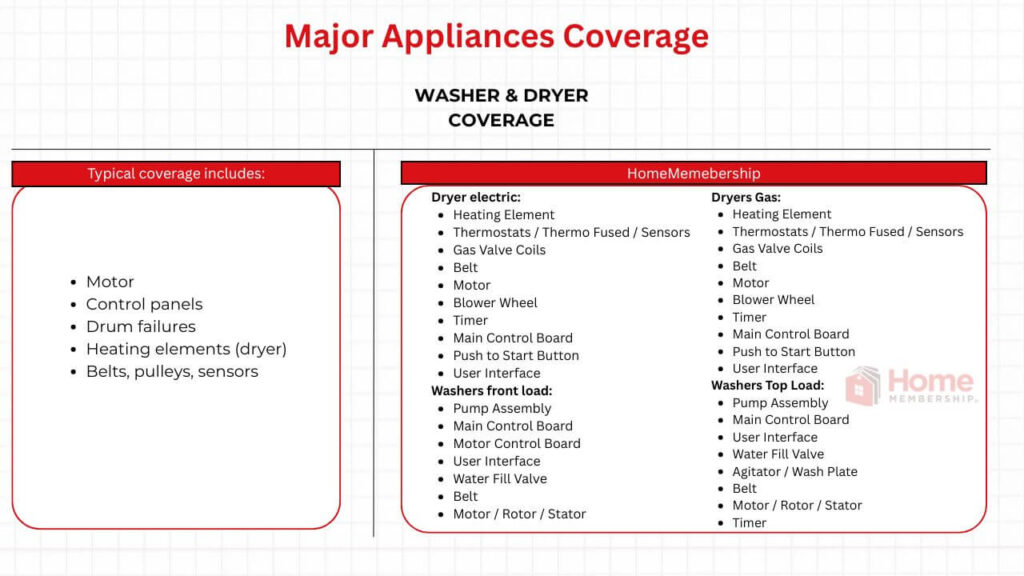
Covered parts generally include:
- Motor
- Control panels
- Drum failures
- Heating elements (dryer)
- Belts, pulleys, sensors
Add-On Coverage (Optional Upgrades)
Add-ons vary significantly between companies and represent an opportunity for personalization.
Common add-ons across the industry:
1. Well Pump
Covers mechanical failures in residential well systems.
2. Septic System
Often includes:
- Tank pumping
- System failures
- Mechanical components
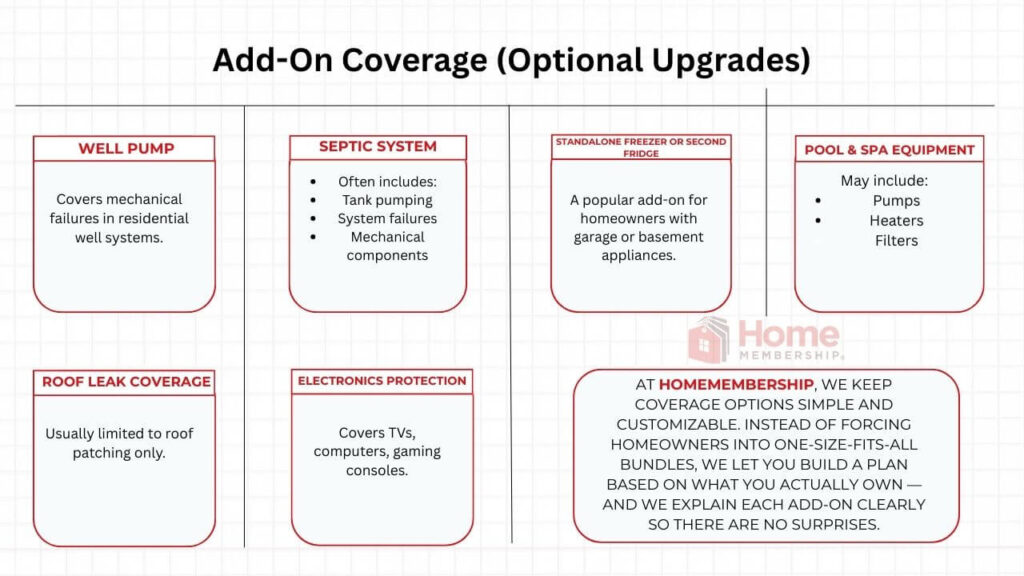
3. Standalone Freezer or Second Fridge
A popular add-on for homeowners with garage or basement appliances.
4. Pool & Spa Equipment
May include:
- Pumps
- Heaters
- Filters
5. Roof Leak Coverage
Usually limited to roof patching only.
6. Electronics Protection (less common)
Covers TVs, computers, gaming consoles.
At HomeMembership, we keep coverage options simple and customizable. Instead of forcing homeowners into one-size-fits-all bundles, we let you build a plan based on what you actually own — and we explain each add-on clearly so there are no surprises.
What Home Warranties Do Not Cover (Clear Exclusions Explained)
One of the biggest sources of confusion in the home warranty industry comes from exclusions.
Every company has them. Every contract uses similar language.
But very few companies explain exclusions in a simple, transparent way.
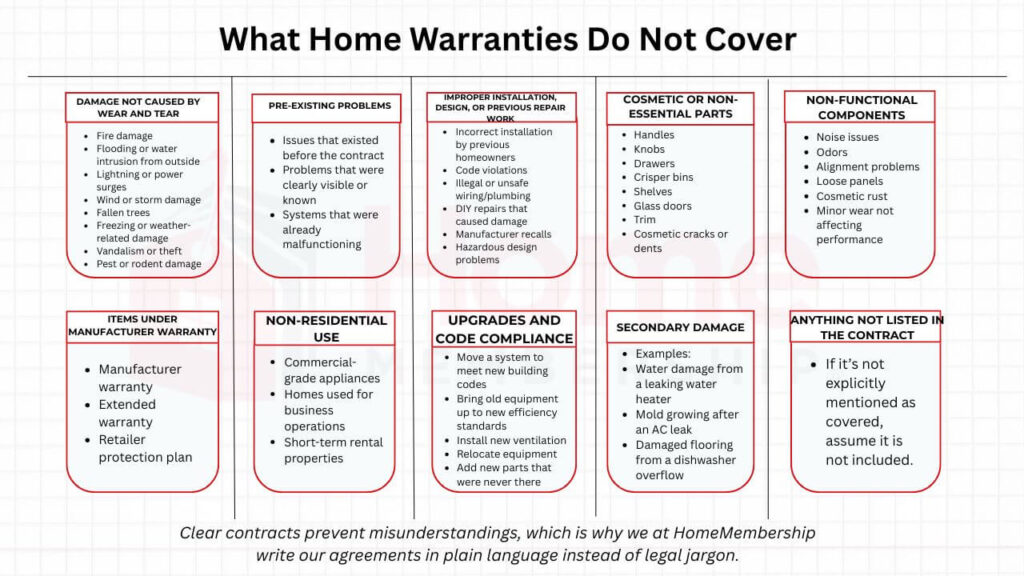
Damage Not Caused by Wear and Tear
Home warranties only cover failures resulting from normal, gradual use.
They do not cover:
- Fire damage
- Flooding or water intrusion from outside
- Lightning or power surges
- Wind or storm damage
- Fallen trees
- Freezing or weather-related damage
- Vandalism or theft
- Pest or rodent damage
These situations fall under homeowners insurance, not a home warranty.
Why:
A warranty is a mechanical-service agreement, not a structural or disaster policy.
Pre-Existing Problems
Most providers exclude:
- Issues that existed before the contract
- Problems that were clearly visible or known
- Systems that were already malfunctioning
At HomeMembership, we focus on fairness, if something is working on day one and fails from wear, we treat it as eligible.
Improper Installation, Design, or Previous Repair Work
A warranty will not cover:
- Incorrect installation by previous homeowners
- Code violations
- Illegal or unsafe wiring/plumbing
- DIY repairs that caused damage
- Manufacturer recalls
- Hazardous design problems
Example:
If a past homeowner installed a furnace incorrectly and it breaks due to that mistake, most providers will deny the claim.
Cosmetic or Non-Essential Parts
Almost all companies exclude:
- Handles
- Knobs
- Drawers
- Crisper bins
- Shelves
- Glass doors
- Trim
- Cosmetic cracks or dents
A home warranty focuses only on mechanical and functional failures.
Non-Functional Components
Anything not affecting essential operation is excluded.
Examples:
- Noise issues
- Odors
- Alignment problems
- Loose panels
- Cosmetic rust
- Minor wear not affecting performance
Items Under Manufacturer Warranty
If an appliance is still under:
- Manufacturer warranty
- Extended warranty
- Retailer protection plan
…then the home warranty usually becomes secondary or does not apply.
Non-Residential Use
Many plans exclude:
- Commercial-grade appliances
- Homes used for business operations
- Short-term rental properties (Airbnb, VRBO) unless specifically covered
Note:
Some providers offer special landlord or rental plans — but not all.
Upgrades and Code Compliance
A warranty does not typically cover the cost to:
- Move a system to meet new building codes
- Bring old equipment up to new efficiency standards
- Install new ventilation
- Relocate equipment
- Add new parts that were never there
- If a component must be updated to meet local code, many companies only pay for the repair itself, not the code upgrade.
When possible, we at HomeMembership aim to guide homeowners through code-related issues so they understand what is required and why.
Secondary Damage
Home warranties do not cover damage resulting from the original failure.
Examples:
- Water damage from a leaking water heater
- Mold growing after an AC leak
- Damaged flooring from a dishwasher overflow
These are insurance claims — not warranty claims.
Anything Not Listed in the Contract
If it’s not explicitly mentioned as covered, assume it is not included.
Clear contracts prevent misunderstandings, which is why we at HomeMembership write our agreements in plain language instead of legal jargon.
See How a Home Warranty Actually Saves Money (In General)
HVAC System Examples (High-Value Scenarios)
1. AC Compressor Failure
Typical repair cost without warranty:
$1,500–$2,700
Full system replacement:
$5,000–$12,000
How a warranty handles it:
- Homeowner pays a service fee ($75–$150 industry average)
- Warranty covers the remaining repair cost, up to coverage caps
Example outcome:
- Compressor replacement cost: $2,300
- Service fee paid by homeowner: $95
- Warranty pays remaining $2,205
At HomeMembership, we focus heavily on transparent HVAC coverage since it’s usually the most expensive system to repair.
2. Furnace Igniter Failure
Typical repair cost:
$250–$650
Warranty scenario:
The homeowner pays the service fee only.
The rest is covered.
Out-of-pocket:
$95 service fee (example)
Savings:
$155–$555
Plumbing System Scenarios
1. Burst Pipe (Interior Only)
Typical repair cost: $350–$900
Warranties generally cover:
- Pipe leaks
- Interior line breaks
- Mechanical plumbing failures
Outcome:
- Homeowner pays service fee
- Warranty covers repair
- Secondary water damage goes to home insurance
This is a common area of misunderstanding, we hope that this article clears it up.
Electrical System Scenarios
1. Breaker Panel Failure
Typical repair/replacement costs:
- Single breaker: $100–$250
- Full panel replacement: $2,000–$4,500
Warranty scenario:
Coverage usually applies to:
- Breakers
- Main board
- Internal wiring components
If the panel needs full replacement and exceeds the cap, the warranty pays up to the limit.
We at HomeMembership try to avoid confusing cap rules — homeowners want clarity, not fine print.
Appliance Scenarios
1. Refrigerator Not Cooling
Typical repair costs:
- Compressor: $700–$1,200
- Control board: $300–$550
Warranty outcome:
- Homeowner pays service fee
- Warranty covers the mechanical repair cost
Cost difference:
- Repair total: $900
- Homeowner: $95
- Savings: $805
Large “Replacement-Level” Failures
These are the scenarios where warranties show their strongest value.
1. Central AC Replacement
Many compressors can be repaired.
But sometimes replacement is required.
Typical replacement cost:
$5,000–$12,000+
Warranty outcome:
Most warranties provide replacement up to cap.
Example cap: $2,500–$5,000 depending on provider.
We aim to keep replacement coverage reasonable and transparent so homeowners know what is included and what portion might be out-of-pocket.
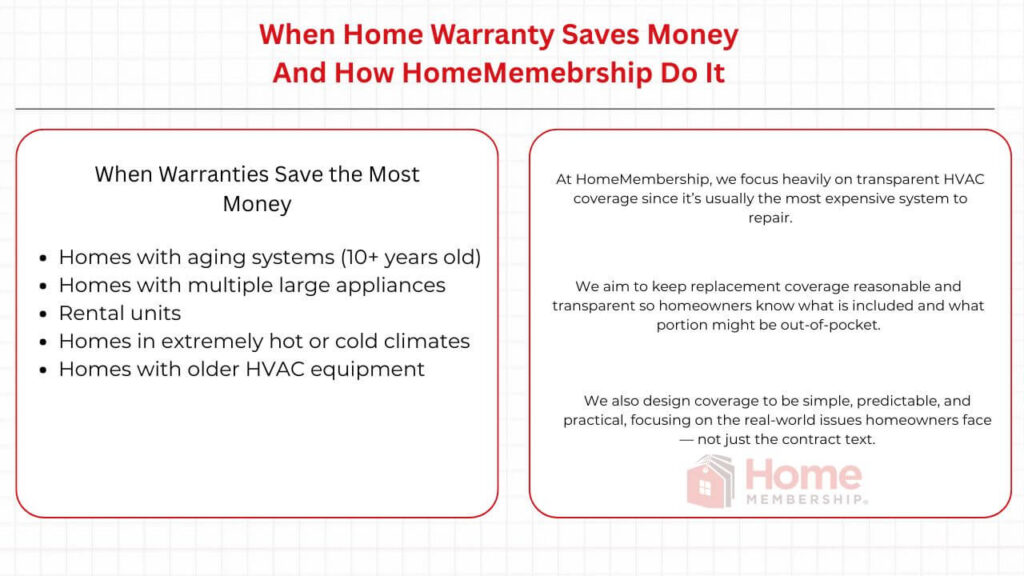
When Warranties Save the Most Money
- Homes with aging systems (10+ years old)
- Homes with multiple large appliances
- Rental units
- Homes in extremely hot or cold climates
- Homes with older HVAC equipment
We at HomeMembership design coverage to be simple, predictable, and practical, focusing on the real-world issues homeowners face — not just the contract text.
Pricing, Coverage Caps, Service Fees & Market Data
Here’s a deep dive into how pricing works in the home warranty world, using our data at HomeMembership plus broader marketplace context. This will give you clarity that many competitors don’t provide.

HomeMembership Pricing Overview
At HomeMembership we aim for transparency and simplicity. Key figures:
- Monthly premium for our “Warranty Membership”: $54.40/month (when paid via checking account) or $64/month (credit/debit).
- Annual pay-in-full option: $768/year.
- Service/deductible (technician visit fee) starts at: $25.
- Coverage scope: Over 120+ items covered.
- Coverage caps: The plan includes specified limits (for example, water heater replacement up to a combined part + labor coverage of $950 in one category).
Why these numbers matter
- Compared to national averages (which might charge $75–$150 service fees), $25 is very low and improves perceived value.
- Premium around $54/month is competitive for full-scope warranty coverage.
- Clear coverage chart with part + labor limits gives transparency many providers lack.
Coverage Caps & Limits — From HomeMembership Data
Here are sample caps from our plan to illustrate how actual numbers work:
| Category | Sample Part + Labor Cap | Notes |
| Water Heater Replacement | $650 part + 3 hrs labor ($300) = $950 total cap | Shows combined part + labor structure |
| HVAC Compressor | $900 part + 4 hrs labor ($400) = $1,300 total cap | Sets realistic ceiling for high-value part |
| Electrical Panel | $375 part + 2.5 hrs labor ($250) = $625 total cap | Reflects a moderate cap in electrical category |
| Outlets / Standard Wiring | $25 part + 1 hr labor ($100) = $125 total cap | Shows how low-cost repairs are capped |
These caps help homeowners understand maximum exposure and also assist in comparing providers.
Service Fee (Deductible) Comparison
- HomeMembership: $25 service fee (exceptionally low)
- Market average: Usually $75–$150 per claim. For example, many national warranty companies charge around $125.
Implication:
Lower service fee means you realize value earlier — the break-even point is smaller. When you pair a $54/month premium with a $25 service fee, homeowners may feel more comfortable filing claims promptly rather than delaying.
Nationwide Market Data & Benchmarks
To put HomeMembership’s pricing in context:

- Many home warranty plans in the U.S. run $50–$90 per month for a full-coverage plan.
- Service fees: $75–$150 typical.
- Many providers cap high-value repairs like HVAC replacements at lower values or attach large exclusions.
- Some providers make the customer use their contractor network and restrict “choose your own contractor” options — increasing friction.
Cost-Benefit Analysis — HomeMembership Example
Here’s a sample modeled scenario using HomeMembership numbers:
Assumptions:
- Premium: $54.40/month → $652.80/year
- Service fee: $25/claim
- Home experiences 2 claims/year:
- Claim A: Water heater replacement costing $1,400
- Claim B: Dishwasher repair costing $300
Without HomeMembership:
- Pay full: $1,400 + $300 = $1,700
With HomeMembership:
- Annual premium: $652.80
- Service fees: 2 × $25 = $50
- Company covers within cap limits; homeowner pays no excess (assuming within caps)
- Total cost to homeowner: $702.80
Savings: ~$997.20 in that year.
Break-Even/Value Threshold
HomeMembership becomes a strong value when:
- Your expected annual repairs exceed the premium + service fees.
- Your systems and appliances are older (higher breakdown risk).
- Repair costs are high (HVAC, water heater, major appliance).
- You prefer predictable budgeting over unknown large bills.
Given the low service fee ($25) and monthly premium ($54.40), the risk threshold for value is relatively low compared to many providers.
Important Pricing Considerations & Variables
When comparing plans (including HomeMembership’s), watch for these variables:
- Age limits: Some plans exclude older equipment or require additional fees.
- Coverage caps: A high premium doesn’t help if the cap is so low that major repairs exceed it.
- Excluded items: Some plans exclude essential parts (like refrigerant, ductwork) — check coverage charts.
- Service network: Who does the repairs? At HomeMembership you can choose your own contractor — which can affect speed and cost.
- Geographic pricing: Some states/regions have higher labor costs; plans may be priced accordingly.
- Add-ons required: Important items like pool/spa equipment or well pumps may cost extra monthly fees. At HomeMembership, you’ll find add-ons clearly listed.
These advantages increase both perceived and actual value — which means higher homeowner satisfaction and easier ranking and conversion on pages like this.
The Home Warranty Claim Process (Deep Dive)
Most homeowners only really “meet” their home warranty during a claim. A clear understanding of how claims work can prevent frustration and help you get faster resolutions.
1. When to File a Claim
File a claim when a covered system or appliance stops working from normal use, for example:
- AC blows warm air
- Furnace will not turn on
- Water heater stops heating
- Dishwasher will not drain
- Outlets in a room lose power
Do not wait weeks or months. Many contracts require you to report issues promptly once discovered.
2. How to File a Claim
Most providers offer at least one of the following:
- Online portal
- Mobile app
- Phone support
Information you should have ready:
- Your name and property address
- Contract or membership number
- The item that failed
- What you noticed and when
- Any immediate safety issues (water leak, no heat in winter, etc.)
At HomeMembership, we focus on a straightforward, guided process, so homeowners know exactly what will happen next.
3. Dispatching a Contractor
Once your claim is opened, the provider arranges service. This is where different companies operate very differently.
Typical approaches in the industry:
- Network-only model
- Company assigns a contractor from its network
- You must use that contractor
- Limited flexibility if you are unhappy with service
- Hybrid model (our approach)
- We at HomeMembership have preferred pros
- You can also choose your own contractor if you have someone you trust
- This gives homeowners more control over service quality and timing
This “choose your own contractor” option is one of the most meaningful differences in how a home warranty can feel in practice.
4. Paying the Service Fee
When the technician comes out, you pay your service fee (sometimes called a deductible or trade call fee).
Across the industry, these are commonly:
- $75 to $150 per claim
At HomeMembership, the standard service fee is $25, which is significantly lower than many competitors. That keeps repair visits affordable and makes it easier to file a claim when you need help.

5. Diagnosis and Approval
The technician:
- Inspects the system or appliance
- Determines the cause of failure
- Sends a diagnosis and cost breakdown to the warranty company
The provider then:
- Confirms whether the issue is covered
- Verifies that it is not pre-existing, improperly installed, or excluded
- Approves repair or replacement within coverage limits
Good providers communicate decisions clearly. We emphasize plain language explanations so homeowners understand what is covered and why.
6. Repair vs Replacement
If the item can be repaired economically, that is usually the first option.
- Repair is common for: igniters, motors, pumps, control boards, valves
- Replacement happens when:
- The system is too old or damaged to fix
- The cost of repair is close to or exceeds replacement cost
- Parts are obsolete or unavailable
Coverage caps still apply, so the warranty pays up to its limit, and you may choose to upgrade or pay the difference if you want a higher-end model.
7. Timeframes and Expectations
Most homeowners want to know: How long will this take?
Typical timing in the industry:
- Claim intake: Same day
- Contractor assignment: Same or next business day
- Initial visit: Within a few days (sooner for emergencies)
- Parts ordering: A few days to a week, depending on availability
Many state regulations and consumer expectations now push providers to respond promptly to essential services like heat, cooling, and plumbing. We build our processes around realistic but responsive timelines, especially for no-heat, no-cool, or active-leak situations.
8. After the Repair
Once a repair is completed:
- The technician reports completion
- The provider pays the contractor for covered work
- You pay only your service fee (plus any non-covered extras you agreed to, such as upgrades)
If the repair fails again shortly afterward, many providers treat it as a callback, not a new claim. At HomeMembership, we work to resolve recurring issues fairly, looking at whether the failure is tied to the same underlying problem.
Claim Denials Explained (And How To Avoid Them)
Home warranty complaints across the industry often involve denied claims. Many of these denials come from misunderstandings that could be prevented with clearer education.
This section explains the most common reasons claims are denied and how to avoid those situations.
1. Lack of Proper Maintenance
Most contracts require “proper maintenance.”
Common examples:
- Never changing furnace filters
- Not flushing a tank water heater for many years
- Ignoring obvious signs of trouble
If a technician can clearly see that neglect caused the failure, the provider may deny the claim.
How to avoid this
- Replace HVAC filters regularly
- Do basic seasonal checks on your systems
- Address minor issues before they become major failures
- Keep receipts if you hire professionals for maintenance
2. Pre-Existing Conditions
If a system or appliance was already broken, malfunctioning, or not working correctly before coverage started, the failure is considered pre-existing.
This can include:
- AC that never cooled properly
- A water heater that was already leaking
- Appliances that sometimes worked, sometimes did not, before your effective date
We at HomeMembership focus on fairness here. If something is running at the start of your membership and fails later due to wear, we treat it as eligible, subject to inspection and contract terms.
3. Improper Installation or Code Violations
If a technician discovers that:
- The system was installed incorrectly
- The work does not meet local code
- Safety standards were not followed
The provider may deny the claim, or may only cover part of the work.
4. Items or Parts Not Listed as Covered
If something is not mentioned as covered in the contract, it is usually excluded by default.
Typical examples:
- Cosmetics like doors, drawers, shelves
- Accessories like ice makers, water dispensers, or door seals, if not explicitly covered
- Certain types of specialty equipment
This is why it is critical to read your plan documents and coverage charts before you need them.
5. Secondary or Resulting Damage
Warranties cover the mechanical failure itself, not the damage it causes.
For example:
- A water heater leaks and ruins flooring
- A dishwasher overflow damages cabinets
The warranty may cover the water heater or dishwasher repair or replacement, but the flooring and cabinetry are policies for your homeowners insurance.
6. Exceeded Coverage Caps
If a repair or replacement goes beyond the contract’s coverage limit, the provider pays up to that limit and the homeowner is responsible for the balance.
Clear caps are not a bad thing. Hidden or unclear caps are.
At HomeMembership, we list caps in a transparent coverage grid so homeowners can realistically see what is protected.
7. How To Minimize Denials
You can greatly reduce denial risk by:
- Performing basic maintenance
- Reporting issues promptly
- Reading your contract and coverage charts
- Asking your provider to clarify gray areas before a claim
- Keeping documentation of previous repairs and service
Home Warranty vs Homeowners Insurance vs Manufacturer Warranty
These three protections often overlap in homeowners’ minds, but they have very different roles.
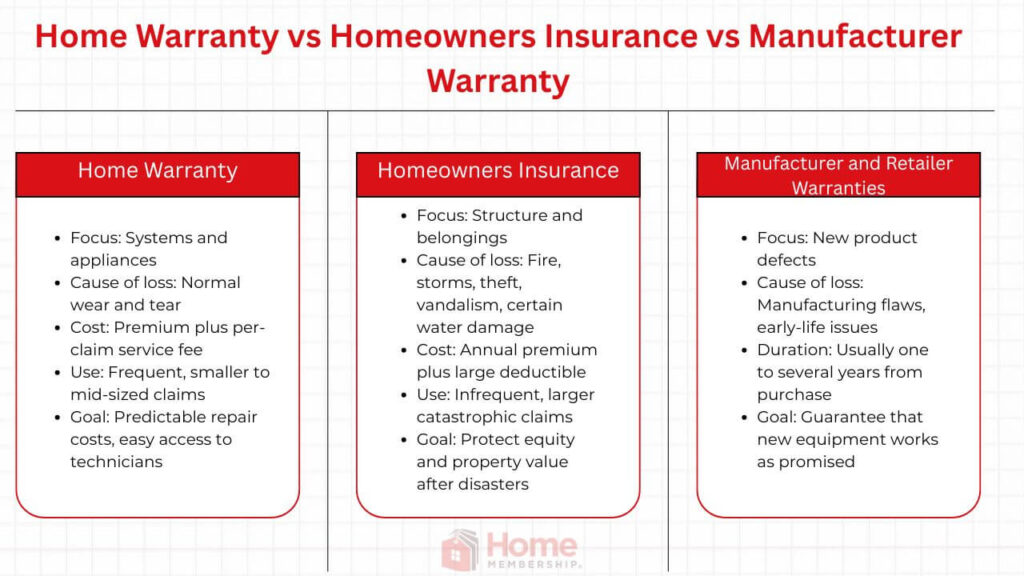
1. Home Warranty
- Focus: Systems and appliances
- Cause of loss: Normal wear and tear
- Cost: Premium plus per-claim service fee
- Use: Frequent, smaller to mid-sized claims
- Goal: Predictable repair costs, easy access to technicians
2. Homeowners Insurance
- Focus: Structure and belongings
- Cause of loss: Fire, storms, theft, vandalism, certain water damage
- Cost: Annual premium plus large deductible
- Use: Infrequent, larger catastrophic claims
- Goal: Protect equity and property value after disasters
3. Manufacturer and Retailer Warranties
- Focus: New product defects
- Cause of loss: Manufacturing flaws, early-life issues
- Duration: Usually one to several years from purchase
- Goal: Guarantee that new equipment works as promised
4. Extended Warranties and Credit Card Protection
Some homeowners also have:
- Store extended warranties for specific items
- Credit card benefits that extend manufacturer warranties
These are usually product-specific and limited in duration.
5. Which Coverage Handles What?
Example: AC failure from age
- Home warranty: Likely covered
- Insurance: No
- Manufacturer warranty: No if older than warranty period
Example: Roof damage from a windstorm
- Home warranty: No
- Insurance: Yes
- Manufacturer warranty: No
Example: Brand-new fridge with a factory defect
- Home warranty: Possibly, but manufacturer warranty is primary
- Insurance: No
- Manufacturer/retailer: Yes
Home warranties are best thought of as everyday breakdown coverage, not as disaster insurance or a replacement for product warranties.
Who Gets the Most Value From a Home Warranty?
A home warranty is not ideal for every single homeowner, but it can be highly valuable for specific situations.

1. Owners of Older Homes
Homes more than 10–15 years old often have:
- Aging HVAC systems
- Original water heaters
- Original appliances
- Older plumbing and electrical
These systems are more likely to fail. A warranty can smooth out the repair cost curve.
2. First-Time Homebuyers
First-time buyers are often:
- New to home maintenance
- Unsure of the home’s repair history
- Budget-conscious after closing costs
A home warranty can provide peace of mind during the first year or two of ownership, especially when you do not yet know how the home behaves season to season.
3. Busy Professionals and Families
If you do not have time to:
- Research contractors
- Collect multiple quotes
- Manage scheduling and follow-ups
then a home warranty can offer convenience, predictable pricing, and one point of contact.
4. Landlords and Rental Property Owners
For landlords, a home warranty can help:
- Control repair costs across multiple units
- Simplify managing tenant repair requests
- Stabilize budgets across seasons
We at HomeMembership see strong adoption among landlords who want predictable cash flow and standardized service processes.
5. Remote or Out-of-State Owners
If you own a home from a distance:
- Vacation home
- Second home
- Investment property
A home warranty can provide local contractor coordination and reduce the stress of managing issues remotely.
6. Sellers and Buyers in Real Estate Transactions
A one-year home warranty is often included:
- As a seller benefit to increase buyer confidence
- As a buyer benefit negotiated in the purchase contract
This can reduce post-closing disputes over system failures and builds trust in older properties.
How To Choose the Right Home Warranty Provider
Not all home warranty companies operate the same way. A smart selection saves you money and headaches.
1. Check Regulation and Licensing
Verify that the company:
- Is registered or licensed where required in your state
- Is compliant with state service contract laws
- Has a backing insurer or financial backing where required
(State regulators, consumer protection offices, and insurance departments often provide search tools.)
2. Read the Actual Contract
Do not buy based only on the marketing page.
Check:
- What is covered
- What is excluded
- Coverage limits
- Caps per item and per term
- Waiting periods
- Maintenance requirements
At HomeMembership, we focus on plain-language agreements that homeowners can actually read without legal training.
3. Understand Pricing and Fees
Compare:
- Monthly or annual premium
- Service fee per claim
- Any additional fees for emergency service
- Add-on pricing for extras like pool or second fridge
A low monthly price paired with a very high service fee might not be a good value for frequent users.
4. Evaluate Coverage Depth
Look closely at:
- HVAC coverage, especially limits and refrigerant policies
- Water heater and plumbing coverage
- Electrical system coverage
- Appliance lists and excluded brands or types
Make sure the plan aligns with the age and value of your systems and appliances.
5. Ask About Contractor Policies
Key questions:
- Do I have to use your network contractors only?
- Can I choose my own contractor?
- How do you handle disputes over quality of work?
We at HomeMembership allow you to choose your own contractor, which many homeowners prefer because it gives them more control.
6. Read Independent Reviews
Look at:
- Google reviews
- Better Business Bureau
- Third-party review sites
- Consumer forums and local groups
Look not only at the rating but at patterns in complaints, especially related to claims and customer service.
7. Look for Transparency
Be wary of companies that:
- Avoid showing sample contracts
- Do not publish service fees and caps up front
- Obscure key terms in fine print
Transparency is often a better predictor of a fair experience than marketing promises.
The Role of HomeMembership
Throughout this guide, you have seen how home warranties work in general. Here is how we at HomeMembership align with and differ from typical providers.
1. Membership and Pricing Structure
- We operate on a membership-style plan with a competitive monthly premium and an option for annual payment.
- Our service fee is $25 per claim, which is notably lower than many national competitors that often charge $75 to $150.
This lowers the barrier to actually using the warranty instead of fearing the per-visit cost.
2. Coverage Depth and Clarity
- We cover 120-plus items across systems and appliances, which creates broad protection for most homes.
- We publish clear coverage charts and caps that combine parts and labor limits, so homeowners can see realistic coverage expectations.
The goal is not to hide behind fine print but to prevent surprises.
3. Choose Your Own Contractor
One of our biggest practical differences is contractor flexibility:
- You can use our preferred network
- Or you can choose your own local contractor if you already have someone you trust
This increases trust, control, and often speeds up repair timelines.
4. Education-First Approach
This page itself is an example of our philosophy:
- We prioritize education over hype
- We explain both pros and cons of home warranties
- We encourage homeowners to read and understand contracts, even if they choose another provider
We believe that informed homeowners are more satisfied homeowners.
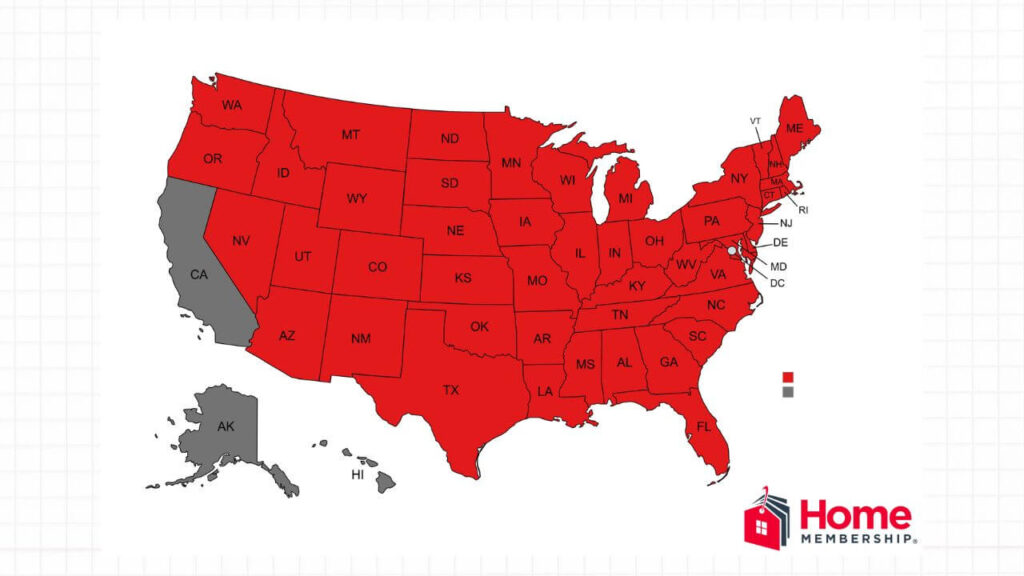
Which State is not Covered by Home Warranty?
Each home warranty company chooses which states it wants to be licensed in and operate in.
Many providers do not operate nationwide because licensing and compliance in all 50 states is expensive and complex.
Common patterns across the industry
- Alaska & Hawaii
A lot of home warranty companies do not operate in Alaska or Hawaii, or only offer very narrow coverage, because of:
- Long distances
- High travel and labor costs
- Supply-chain issues for parts
- Difficulty building and managing contractor networks
This is similar to why HomeMembership doesn’t service those states.
- States with strict or unique service-contract laws
Home warranty companies are regulated at the state level, and each state has its own rules (insurance department, real estate commission, commerce department, etc.). - Getting licensed in all 50 states means dealing with 50 different regulatory frameworks, financial requirements, and filings. Many companies skip some states because the legal/compliance effort is too high compared to expected business.
- Example: some companies historically avoided or delayed entering New York or California because those states treat service contracts more like insurance, with tougher oversight.
- States where a specific company has been restricted or banned
- Sometimes a regulator will prohibit a particular company from selling in that state if they violate rules or have too many compliance issues.
- Example: in Georgia, the Insurance and Safety Fire Commissioner prohibited Choice Home Warranty from selling or soliciting home warranty/service contracts in the state in 2024 due to regulatory actions.
- That doesn’t mean no home warranties exist in Georgia; it just means that specific providers are not allowed to sell there.
At HomeMembership, we currently offer coverage in most U.S. states, but not in California, Alaska, or Hawaii, largely due to a mix of regulatory and logistics constraints. Across the broader home warranty industry, availability also varies by company. Many providers do not operate in every state because each state has its own licensing and service-contract rules, and some companies are restricted or banned in certain states after regulatory actions. That’s why you’ll sometimes see one provider available in your state while another is not.
Conclusion: What is Home Warranty Really
A home warranty is:
- A service contract that helps cover the cost of repairing or replacing major home systems and appliances when they fail due to normal wear and tear
- A way to stabilize your home budget, trading surprise thousand-dollar repairs for predictable payments and modest service fees
- A practical tool for homeowners with aging systems, limited time, or a desire for predictable maintenance and repair support
It is not:
- A replacement for homeowners insurance
- A guarantee that every claim will be approved
- A solution for disasters, neglect, or cosmetic issues
Related Posts